

Spain
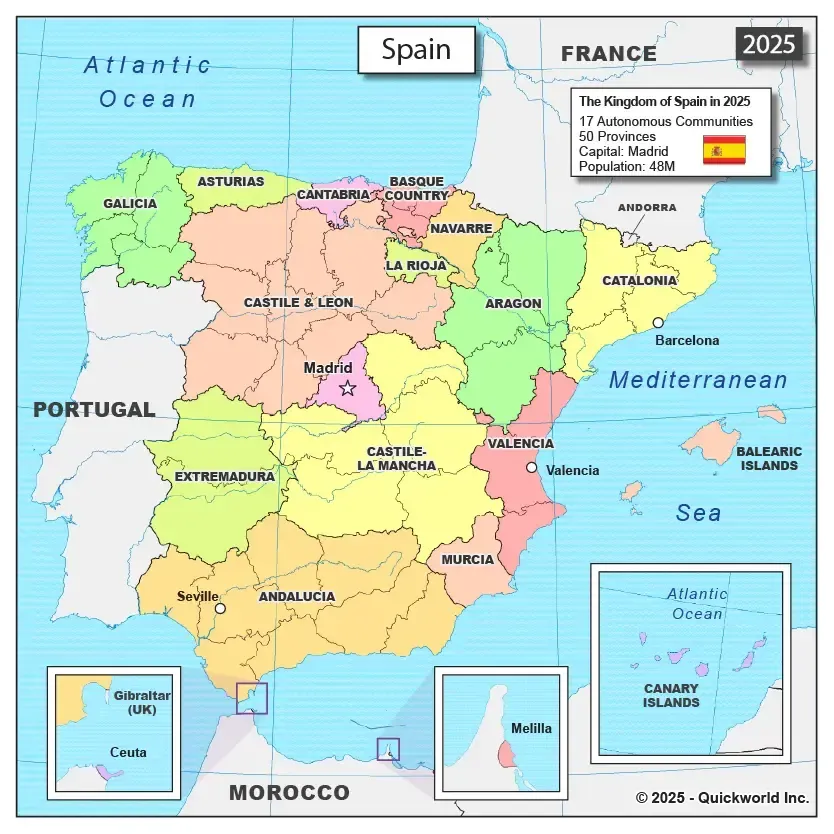
Spain is a land of passion and artistic expression, long renowned worldwide for its bullfighting, dance, and guitar music. It boasts outstanding tourism resources, with much of the country enjoying a mild climate, picturesque mountains and waters, abundant sunshine, and stunning scenery. Spain is home to numerous royal palaces, churches, and castles, as well as ancient and distinctive ethnic traditions and unique cultural and recreational activities.
Since prehistoric times, Spain has been influenced by external cultures. During the Middle Ages, multiple kingdoms coexisted, and by the 15th century, Spain emerged as a unified nation. In modern history, Spain became an important cultural cradle. During the Renaissance, it was one of Europe’s most powerful nations, and from the mid-15th to the late 16th century, it grew into a world-influencing empire. Today, approximately 500 million people speak Spanish, making it the third most widely spoken language in the world.
Madrid, the vibrant capital of Spain, is also a renowned cultural city filled with historic landmarks and a strong artistic atmosphere. It is home to world-class museums such as the Prado Museum and the Reina Sofía National Art Center, as well as iconic sites like the Royal Palace and Plaza Mayor. Madrid is also famous for its lively tapas bars and energetic nightlife.
Barcelona is internationally recognized as a city that seamlessly blends ancient and modern civilizations, and it is a true haven for artists. Throughout the city, visitors can admire masterpieces by world-famous artists such as Picasso, Gaudí, and Miró, including landmarks like the Sagrada Família, Casa Batlló, and Park Güell. With its pleasant climate, breathtaking scenery, and abundance of historic sites, Barcelona is known as the “Pearl of the Iberian Peninsula” and is one of Spain’s premier tourist destinations.
Advantages of Learning Spanish
The Global Importance of Spanish and its Benefits for Study and Work
Spanish has over 500 million speakers, covering Europe, Latin America, and even parts of Africa and Asia.Increasing Global OpportunitiesMastering Spanish can open global learning opportunities, with many countries offering various scholarships and exchange programs.
Expanding Global Opportunities
Mastering Spanish can open doors to global learning opportunities. Many Spanish-speaking countries are home to world-class universities and academic institutions, offering a wide range of scholarships and exchange programs.
Career Competitiveness
Mastering Spanish can provide more opportunities in fields such as education, translation, tourism, international trade, and diplomacy.
Enhancing University Application Competitiveness
Fluent Spanish skills and a deep understanding of the culture can significantly enhance a student's competitiveness when applying to Spanish universities.
Rich Cultural Activities
From traditional Flamenco dance to modern art exhibitions, study tour participants can experience the charm of Spain from all perspectives.
Spanish Language Courses
Accelerated Courses (Intensive)
Specifically designed to accelerate the
improvement of grammar, communication, comprehension, and writing skills. Learning results appear immediately in a short period.
The course is taught by two different native teachers; two unique teaching styles enhance the student's learning experience.
The Accelerated Spanish course is ideal for students who need to meet long-term visa requirements.
Semi-Intensive Courses
A perfect choice for those with limited study time or those seeking a balance between work/travel and their course.
Ideal for students who only wish to apply for a tourist visa (not exceeding 90 days).
Spanish Proficiency Exams
Dele
DELE (Diplomas de Español como Lengua Extranjera)
The DELE examinations were established in 1989 by the Spanish Ministry of Education, Culture, and Sport. DELE certificates are valid for life and offer proficiency levels aligned with the Common European Framework of Reference for Languages (CEFR), ranging from A1 to C2.
The exam consists of four components: Reading Comprehension, Listening Comprehension, Written Expression, and Oral Expression. It is conducted in a traditional paper-based format at authorized examination centers, with fixed exam dates each year.
High Recognition: Officially certified by the Spanish Ministry of Education and widely recognized for academic, professional, and immigration purposes
Validity: Lifetime validity
Flexibility: Lower flexibility, as candidates must register for a specific level
Results Release: Longer processing time; results may take several months
Exam Format: Paper-based exam with limited test sessions each year
Comprehensive Assessment: Evaluates both language knowledge and practical application skills
Best For: Long-term goals requiring official proof of Spanish proficiency, such as academic advancement or long-term career planning
Siele
The SIELE exam is designed for adults who use Spanish as a foreign language, second language, or mother tongue. It was jointly developed in 2016 by the University of Salamanca (USAL), Instituto Cervantes (IC), National Autonomous University of Mexico (UNAM), and the University of Buenos Aires (UBA). The exam reflects the characteristics of Spanish from different regions, ensuring linguistic diversity.
The full exam consists of four components: Reading Comprehension, Listening Comprehension, Written Expression, and Oral Expression. Candidates may choose to take the complete exam or select one or several modules to assess specific language skills.
Recognition: Relatively new; recognition is steadily increasing, though it may not yet be as widely accepted as DELE
Validity: Valid for five years
Flexibility: High flexibility with multiple module combinations available
Result release: Fast results, usually within three weeks
Exam format: Fully computer-based, including testing and score reporting; offered on multiple dates throughout the year
Exam content: Depending on selected modules, the testing scope may be more limited
Best For: SIELE is ideal for situations requiring a quick assessment of Spanish proficiency, such as short-term study, job applications, or emerging career opportunities.
Spanish Visa Categories
Long-term Study Visa
For students planning to study in Spain for 12 months.
Requires a detailed study plan, admission letter, and financial proof.
Must apply for a residence permit at a local police station after arrival.
May allow work under limited conditions (e.g., university students).
Can be renewed or changed within Spain.
Family members may be eligible to apply for accompanying status.
Short-term Study Visa
Applicable to students planning to study in Spain for no more than 90 days.
Application Requirements Students requiring an entry visa:Usually requires a Letter of Acceptance (LOA) from a short-term course, financial proof, etc.
Students not requiring an entry visa: 90-day visa-free tourism status and a Letter of Acceptance (LOA):No need to apply for a residence permit; students may study and stay in Spain within the visa validity period.
Renewal or Change:If the study plan exceeds the visa validity, students usually must return to their home country to re-apply for a long-term study visa.
Work Rights:Short-term study visas generally do not allow holders to work in Spain.
Dependents:Short-term study visas generally do not include the option for accompanying family members.
Spanish Language School
PLT202304001143(LLP0035078-LGN)
P :+60 3-6420 5799
A : T3A-13-10 pusat perdagangan Icon City, 1B SS8/39 SS8 , Petaling Jaya, Malaysia, 47300
Copyright © 2026 MY STUDY HOLIDAY All Rights Reserved
Designed By : ogkohdesign.com

